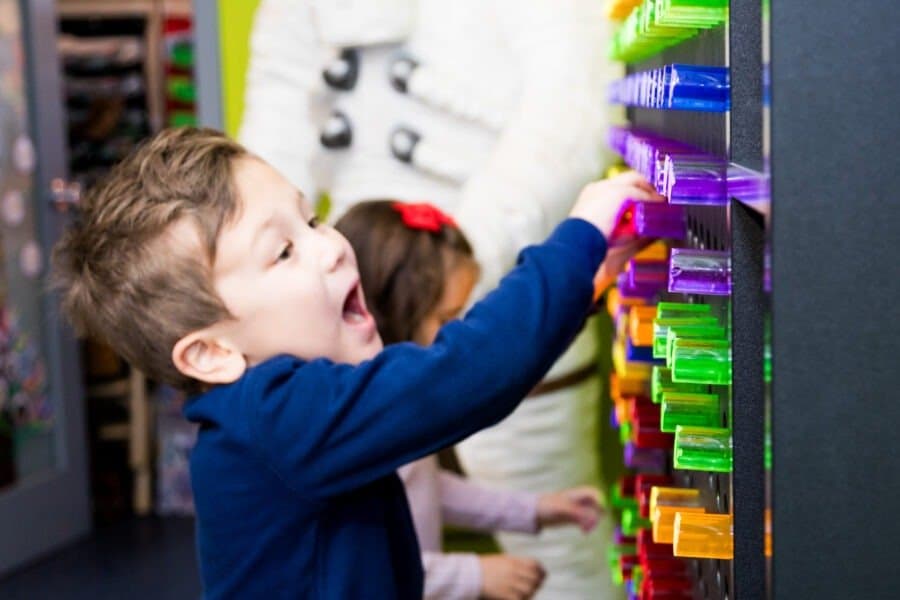





Infants and toddlers develop essential problem-solving and critical-thinking abilities by engaging in hands-on experiments and observations. Through firsthand experiences, they learn to ask questions, make predictions, test ideas, and draw conclusions.
Enhances Language and Cognitive Development
As children interact with materials and phenomena, they acquire new vocabulary and concepts related to science. Describing their observations and sharing discoveries with adults and peers supports language and cognitive growth.
Encourages Sensory Integration and Motor Skills
Hands-on activities involve using multiple senses (sight, sound, touch, etc.) and fine and gross motor skills. This multisensory approach aids in brain development and coordination.
Builds Self-Confidence and Independence
When infants and toddlers are given opportunities for self-directed exploration, they gain a sense of accomplishment and confidence in their abilities. This fosters independence and a positive attitude toward learning.
Sparks Interest in STEM Fields
Engaging in hands-on science at an early age can lay the groundwork for continued interest and success in STEM (Science, Technology, Engineering, and Math) subjects as children grow.
BPoS’ hands-on curriculum nurtures crucial skills like curiosity, problem-solving, language, motor abilities, and STEM foundations in infants and toddlers by providing developmentally appropriate, multi-sensory science experiences through play, exploration, and discovery. This approach supports their overall growth and prepares them for future academic success.
Nature Exploration
Going on nature scavenger hunts and making nature collages
Painting with natural materials like leaves, flowers, etc.
Exploring different textures found in nature
Planting seeds and observing their growth
Physics Concepts
Experimenting with gravity using ramps, tubes, and toy cars
Making and playing with balancing toys to learn about center of gravity
Creating balloon rockets to see Newton’s laws of motion
Weather and Water
Making simple wind chimes and observing wind
Painting puffy clouds and hunting for rainbows
Walking water experiment with food coloring
Rain cloud in a jar with shaving cream and food coloring
Chemistry
Baking soda and vinegar reactions, adding colors
Making oobleck (cornstarch and water mixture)
Mixing colors with milk and soap to see color theory
Making homemade lava lamps
Biology
Observing celery stalks absorb colored water
Watching flowers change color by adding food coloring
Making edible “butterflies” to learn life cycles
Using a DIY stethoscope to listen to heartbeat
Find out more here.